Login
Research at the Cawley Center
Focusing on colorectal, breast, and organoid research
Colorectal Research
In 2026, years of laboratory research by Dr Boman's team crossed an important line: a discovery made at the bench is about to be tested in patients. A study published in October 2026 in the journal Cancer Biology & Therapy shows that two familiar, inexpensive drugs work better against colorectal cancer when they are given together. Based on these findings, a new clinical trial testing this drug combination in patients is moving forward.
The idea behind the work is simple to state. Most cancer treatments try to kill cancer cells. Dr Boman's team is asking a different question: can cancer cells be coaxed into behaving like normal cells again, so that they mature, stop dividing and stop forming tumors?
The lining of the colon is one of the busiest tissues in the body. It replaces itself every few days. New cells are born from stem cells at the bottom of tiny pockets called crypts. As they move upward in the crypt, they mature into the specialized cells that do the colon's work, and at the top they are shed. Previously we described how Dr Boman's team and mathematicians at the University of Delaware found five simple rules that keep this constant renewal precisely organized.
In about 90 percent of colorectal cancers, that organization breaks down because of a mutation in a single gene called APC. The APC gene normally acts as a brake. When it is broken, a growth signal called WNT gets stuck in the "on" position, like a gas pedal pressed to the floor. Stem cells keep multiplying, and too many of them never finish maturing. The result is a crowd of immature, continually-dividing cells, which is the starting point of a tumor.
Two Signals That Must Stay in Balance
Healthy colon tissue depends on a balance between two signals. WNT tells cells to multiply. A second signal, driven by vitamin A, tells cells to stop multiplying and mature. The vitamin A signal works through a natural substance called retinoic acid. Drugs made from vitamin A are called retinoids.
Dr Boman's team discovered that these two signals are linked. In earlier work (2024), they showed that when WNT is stuck "on," it switches on an enzyme called CYP26A1 that breaks down retinoic acid. In other words, the runaway growth signal also destroys the "grow up" signal. That is a double hit: cancer cells are pushed to keep dividing and, at the same time, lose the instruction that would make them mature. When the team restored a working APC gene in cancer cells in the laboratory, the cells once again responded to vitamin A and matured.
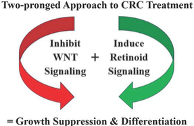 The two-pronged approach. Turning down one growth signal (WNT) while turning up a "grow up" signal driven by vitamin A (retinoids) leads to growth suppression and maturation of colon cancer cells. (Graphical abstract from Hunsu et al., Cancer Biology & Therapy, 2026.)
Triple Negative Breast Cancer Research
The state of Delaware leads the nation in incidence of triple negative breast cancer (TNBC), an aggressive breast cancer subtype that disproportionately affects younger women and Black women. Dr. Scott Seigel and Dr. Jennifer Sims-Mourtada, PhD are combining geospatial profiling with biological research to understand the factors contributing to Delaware’s high incidence. The team has identified regions in Delaware with higher incidence of TNBC than other breast cancer subtypes. These areas, known as TNBC hotspots, are the focus of research to understand how neighborhood exposures and individual factors work together to influencer breast cancer risk. The team has received grant funding investigate Delaware’s TNBC hotspots.
DESPARIT: Detecting Epigenetic Signatures to Prevent Avoidable Racial Inequities in TNBC: This study investigates whether cumulative exposure to reproductive, metabolic, alcohol-related, and environmental risk factors is associated with distinct epigenetic changes in immune cells among women diagnosed with breast cancer who reside in TNBC hotspots. The goal of this project is to identify biological markers of increased TNBC risk that could support earlier screening and targeted prevention.
IGNITE: Inflammation, Genomic and Non-Genomic Interactions in TNBC Etiology: This study, in collaboration with Dr. Endale Gebregzabher at the University of Delaware, investigates how genetic susceptibility and cumulative neighborhood exposures interact to influence inflammation and immune function. The goal is to identify early biological patterns that may signal increased TNBC risk before cancer develops.
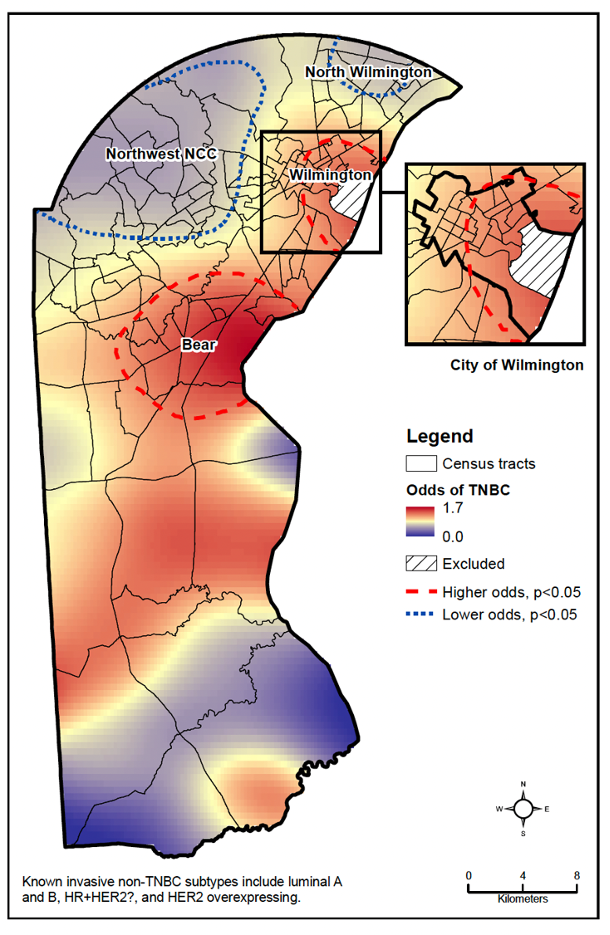 Image from Seigel et al, Cancer Epidemiology, Biomarkers & Prevention, 2021
Publications
Johnson I, Bacchus A, Budziszewski R, Siegel SD, Sims-Mourtada J. Pan-immune-inflammation value: racial variations and differences in prognostic accuracy across breast cancer subtypes at a single institution. Front Oncol. 2026 Mar 6;16:1694711. doi: 10.3389/fonc.2026.1694711. PMID: 41869661; PMCID: PMC13002395.
Siegel SD, Brooks MM, Berman JD, Lynch SM, Sims-Mourtada J, Schug ZT, Curriero FC. Neighborhood factors and triple negative breast cancer: The role of cumulative exposure to area-level risk factors. Cancer Med. 2023 May;12(10):11760-11772. doi: 10.1002/cam4.5808. Epub 2023 Mar 14. PMID: 36916687; PMCID: PMC10242317.
Siegel, S.D., Brooks, M.M., Sims-Mourtada, J., Schug, Z.T., Leonard, D.J., Petrelli, N., & Curriero, F.C. (2021). A population health assessment in a community cancer center catchment area: Triple-negative breast cancer, alcohol use, and obesity in New Castle County, Delaware. Cancer Epidemiology, Biomarkers & Prevention. Advance online publication. (PMID: 34737210).
Siegel, S.D., Brooks, M.M., Lynch, S.M, Sims-Mourtada, J., Schug, J.T., & Curriero, F.C. (2021). Racial disparities in triple negative breast cancer: Toward a causal architecture approach. Research Square. Preprint. Available from: DOI: https://doi.org/10.21203/rs.3.rs-1177963/v1
Research Organoids
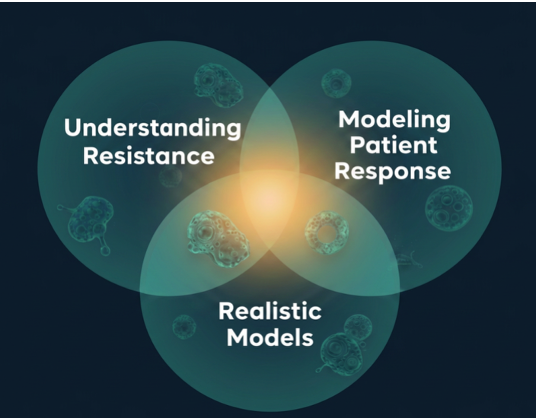
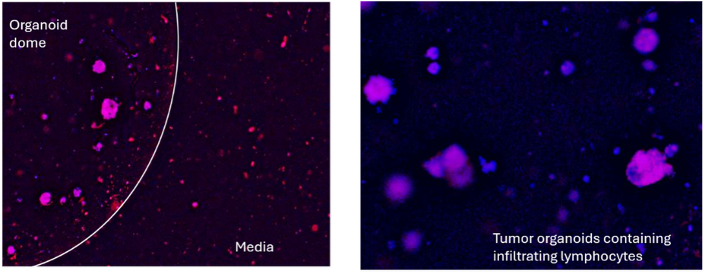
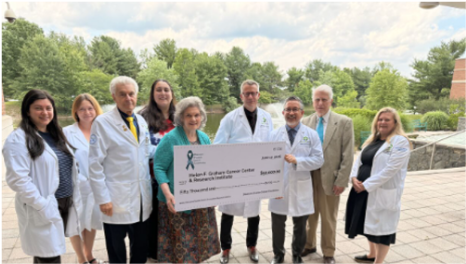
Under the direction of Dr. Sims-Mourtada and Dr. Modarai, organoid research in the Cawley CTCR focuses on breast and ovarian cancers to better understand why some patients respond to treatment and others do not. The team is also developing organoid models of these cancers and other solid tumors that are inclusive of the tumor microenvironment by integrating immune and vascular cells along with patient-derived tumor cells. These projects are supported by funding from the Delaware Ovarian Cancer Foundation
Wistar Partnership
A Unique National Cancer Institute Partnership
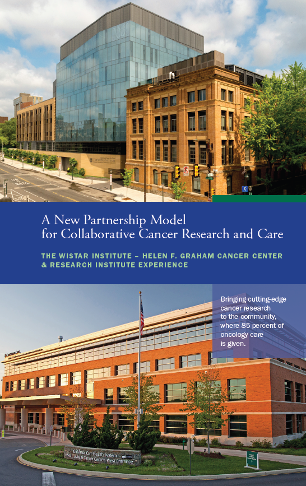
In 2011 , Dario C. Altieri, M.D., President, CEO, and Director of the Ellen and Ronald Cancer Center at The Wistar Institute, and Nicholas J. Petrelli, M.D., FACS, then Medical Director of the Helen F. Graham Cancer Center and Research Institute at ChristianaCare, formed a partnership between the two institutions that would expedite the pipeline of cancer interventions from bench to bedside.
This partnership has yielded more than 42 translational cancer research papers and collaborative grant funds leading to advanced research discoveries made in Wistar labs into early clinical trials and protocols at ChristianaCare. Research in ovarian and colorectal cancer, glioblastoma, pancreatic, esophageal and lung cancer and others are ongoing to find better diagnostic markers for early detection and better treatments for advanced and recurrent cancers. Wistar researchers and Cawley Center Scientists are collaborating to understand Delawares high rates of triple negative breast cancer and develop better prevention strategies.
Wistar and ChristianaCare’s partnership has repeatedly yielded a two-way benefit: basic scientists learn directly from clinicians about the issues those clinicians are seeing at the bedside, and the clinicians learn from the scientists about the challenges the scientists face as they try to solve problems that will ultimately lead to clinical solutions.
Contact Us
Helen F. Graham Cancer Center & Research Institute
4701 Ogletown-Stanton Road
Suite 2200
Newark, DE 19713